Eye Link Belt for OEM Equipment & Custom Replacement
Match product support, open area, belt pitch, edge construction and sprocket engagement to your equipment. JBL Mesh Belt supports OEM builders, distributors and replacement buyers from specification review through delivery follow-up.
A drawing, existing belt photos or a physical sample are enough to start the review.
Width options
300-3000 mm / Custom
Material options
Mild Steel / SUS304 / SUS316
Start with Your Project
What Do You Need the Eye Link Belt to Do?
The right starting point depends on whether you are building equipment, supplying a customer or replacing an installed belt.
OEM Equipment Builders
Designing a new freezing, washing or processing line?
Share product size, load, belt width, transfer points and drive arrangement. We will review the carrying surface, open area and sprocket interface with your equipment requirements.
Send the drawing, sample reference, required quantity and document needs. We will identify the dimensions and options that must be confirmed before quotation.
Replacing a worn belt or solving a drive mismatch?
Start with photos of the full belt, both edges, sprockets and the problem area. Include the dimensions you know or send a sample when the original drawing is unavailable.
These reference options come from the current Eye Link Belt technical specification. Final dimensions, material and tolerances follow the agreed drawing or sample.
Open the original specification page to see the measurement positions and project fields.
Eye Link Belt specification options and project confirmation points
Parameter
Specification Options
Confirm for Your Project
Material
Mild Steel / SUS304 / SUS316
Confirm temperature, corrosion, hygiene and product-load conditions
Eye-link pitch
3.6 / 5 / 6 / 8 / 10.5 / 12 mm
Confirm product support and required open area
Rod pitch
25.4 / 50 / 50.8 / 76.2 mm / Custom
Match the belt, edge route and sprocket design
Wire diameter
1.6 / 2.0 / 2.5 mm
Confirm against product support and load
Reinforcement wire
2.0 / 2.5 mm; single / double
Confirm whether reinforcement is required
Cross-rod diameter
5.0 / 6.0 / 8.0 mm / Custom
Confirm width, load and drive arrangement
More width, edge, accessory & sprocket details
Eye Link Belt specification options and project confirmation points
Parameter
Specification Options
Confirm for Your Project
Belt width
300-3000 mm / Custom
Final width follows the agreed drawing or sample
Belt length
Custom
Confirm equipment route and required joining method
Edge treatment
Roller Chain / Reinforced Plate
Confirm chain, plate, clearance and drive interface
Choose the Surface, Edge and Accessories to Review
The images below are original materials from the current technical specification. They illustrate configuration routes; your project still needs dimensional and operating-condition confirmation.
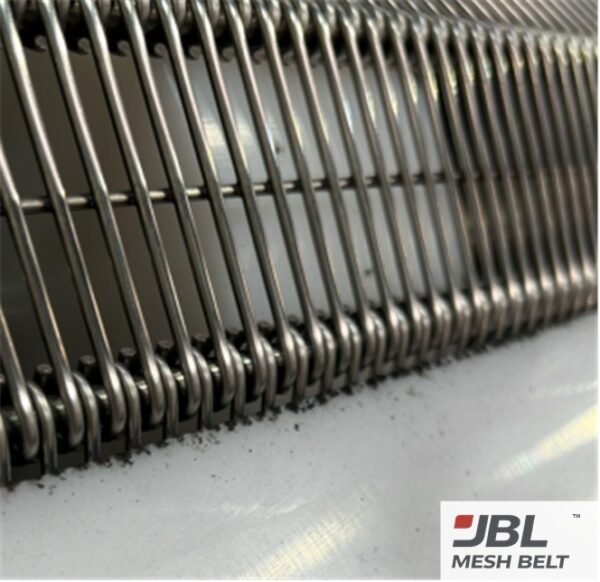
Eye Link Belt Surface
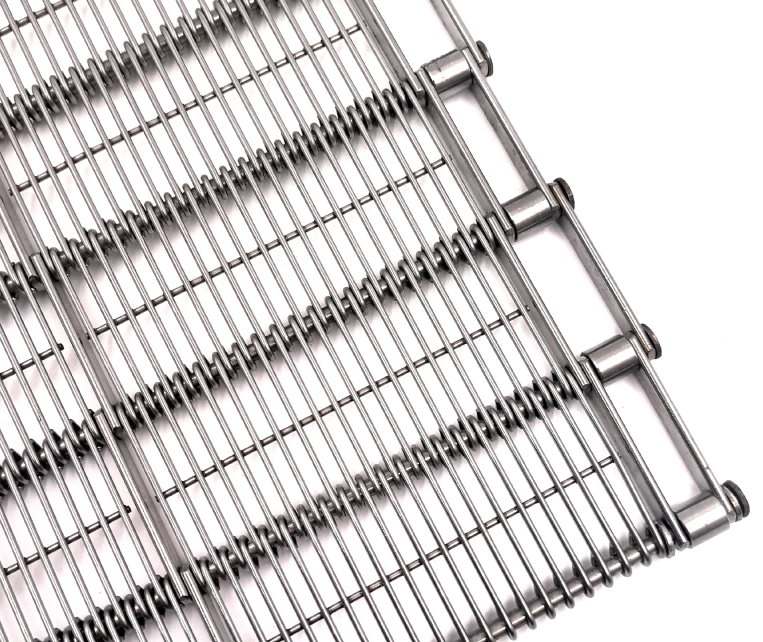
Original overview from the current technical specification. Confirm pitch, rod, width and edge arrangement for the project.
Reinforced Plate Edge
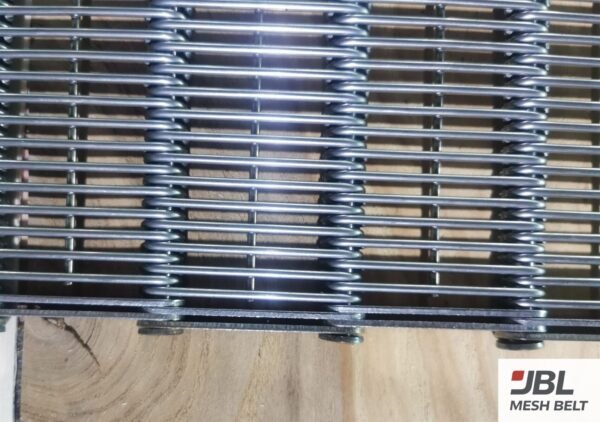
Plate-edge construction shown in the technical specification. Check edge clearance and rod-end arrangement against the equipment.
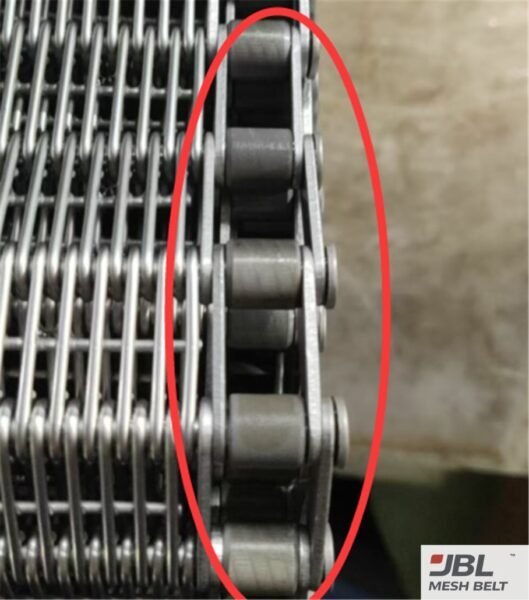
Roller Chain Edge
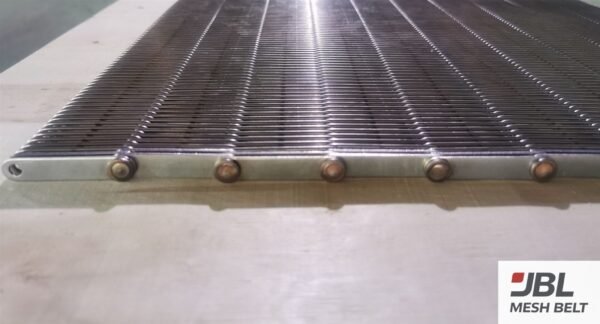
Roller-chain edge construction shown in the technical specification. Match chain data and sprocket engagement before production.
More material, reinforcement, groove, flight & sprocket options
SUS304 Surface Example
The source specification labels this example as SUS304. Confirm the order material through the agreed specification and material record.
SUS316 Surface Example
The source specification labels this example as SUS316. A photograph alone does not verify material grade.
Reinforced Plate Option
A reinforcement option for projects where the width, load or equipment layout requires additional support.
Groove-Type Structure
A formed structure option from the technical specification. Confirm its purpose and dimensions for the product route.
Flights
Flights can be reviewed for product control or incline handling. Height, spacing and weld arrangement are project-specific.
Matched SUS304 Sprocket
A sprocket example from the technical specification. Tooth profile, teeth, bore and keyway must match the confirmed belt route.
Inspection Photos & Videos
Use Measured Evidence to Confirm the Order
The readings below belong to the photographed samples. They show how a dimension can be recorded; they do not replace your approved project specification.
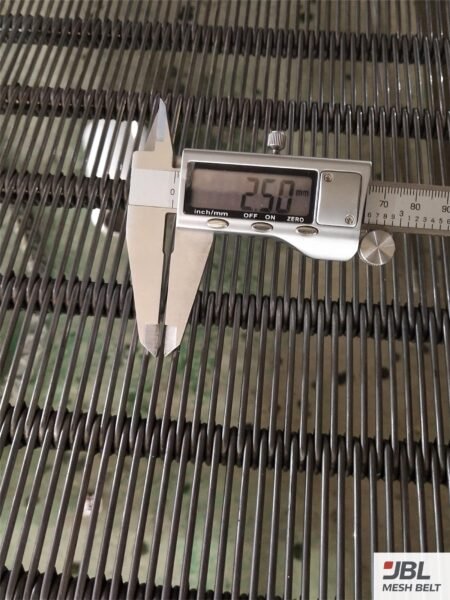
25.4 mm Rod-Pitch Example
The displayed sample reading is 25.40 mm. Your order follows the value on the agreed drawing.
50 mm Rod-Pitch Example
The displayed sample reading is 50.00 mm. It is a reference example, not a universal dimension.
50.8 mm Rod-Pitch Example
The displayed sample reading is 50.80 mm. The specification also lists 76.2 mm and custom routes.
Manual Sprocket Engagement Check
0:08
Workshop footage shows a sprocket moved manually across the belt to view tooth contact. It is not an installed equipment running test.
Second Manual Sprocket Fit View
0:08
A second hand-moved sprocket view for engagement discussion. Final fit requires the confirmed pitch, tooth profile and equipment data.
Agree the Checks That Matter to Your Order
Material and surface-treatment documents
Eye-link pitch, rod pitch, wire and rod dimensions
A belt can look similar and still differ at the pitch, edge or sprocket interface. Show the condition and equipment together before changing a dimension or structure.
Sprocket noise, jumping or edge wear
Review rod pitch, chain or plate edge, sprocket profile, tooth count, shaft position and visible wear together. One measurement cannot confirm the complete drive fit.
Product marking, sagging or poor drainage
Compare product size and load with eye-link pitch, wire diameter, rod pitch, reinforcement and required open area before changing the belt construction.
Repeat belt with no complete drawing
Photograph the full surface, both edges, joining area and sprockets. Add width, pitch, wire, rod and edge dimensions or provide a sample for review.
What to Send for Replacement Review
Full belt, both edges, damaged area, sprockets, installed-line view, known dimensions and operating notes. Send a sample if the original drawing is unavailable.
What Should You Confirm Before Ordering an Eye Link Belt?
Quick answer
Confirm five things on a drawing and a trial section before bulk: the eye-link surface (wire and links), whether reinforcement is needed, the edge type, the sprocket fit, and the material for your temperature and cleaning. I show each one below with readings from two real projects.
Spring Liu
Sales Director, JBL Mesh Belt · 16 years in metal conveyor belts
Checkpoint
What you confirm
Real project
1. Surface
Wire diameter, edge link height and thickness
Australia, 2020
2. Reinforcement
Needed or not; checked on the trial section
Australia, 2020
3. Edge
Reinforced plate edge or roller-chain edge
Australia, 2020 and 2023
4. Sprockets
Sprocket specification confirmed with you before production
Australia, 2020 and 2023
5. Material
Stainless, mild steel or a heat-resistant chain edge
Australia, 2023
Both projects below were ordered by an Australian distributor: a SUS304 eye link belt with sprockets in 2020, and a mild steel eye link belt with a 2Cr13 roller-chain edge and four sprockets in 2023. In both, a drawing was confirmed and a trial section measured and sent to the customer before bulk production. Production is carried out by our qualified production partners to the approved drawing; engineering review and pre-shipment inspection are done by JBL.
Checkpoint 1 of 5
Which details of the eye-link surface should you confirm?
The surface carries your product. Wire diameter and the edge links decide how stiff it is and how it sits on the sprockets.
Confirm wire diameter, eye-link pitch and the edge link height and thickness on the drawing, then check them with a caliper on the trial section. On the 2020 Australian belt I read wire 2.50 mm, edge link height 12.00 mm and edge link thickness 2.00 mm.
Wire diameter: 2.50 mmEdge link height: 12.00 mmEdge link thickness: 2.00 mm
Reference options and what was read
Dimension
Options in the current specification
Australia 2020 reading
Wire diameter
1.6 / 2.0 / 2.5 mm
2.50 mm
Eye-link pitch
3.6 / 5 / 6 / 8 / 10.5 / 12 mm
Per approved drawing
Rod pitch
25.4 / 50 / 50.8 / 76.2 mm / custom
50 mm on the approved drawing
Edge link height
Per drawing
12.00 mm
Edge link thickness
Per drawing
2.00 mm
A pitch outside the listed options needs a separate check, so I raise it at the start of the review. Final values always follow your approved drawing.
Checkpoint 2 of 5
Do you need reinforcement — and how is it checked?
Reinforcement stiffens wide or heavily loaded belts. It has to be on the drawing and checked on the trial section, not assumed.
Decide on reinforcement during the drawing review and check it on the trial section. On the 2020 trial section the reinforcement wire read 2.51 mm and the reinforcing plate 2.00 mm before bulk production started.
Trial section: reinforcement wire 2.51 mmTrial section: reinforcing plate 2.00 mmReinforcing plate along the belt edge
What I check on reinforcement
Check
Why it matters
Wire or plate size against the drawing
Too light and the surface sags under load
Straightness
A bent reinforcing wire makes the surface uneven and can mark the product
Eye type
Some hooked eye designs leave little room for a reinforcing wire
Single or double
Decided by width and load during the drawing review
Checkpoint 3 of 5
Reinforced plate edge or roller-chain edge?
The edge decides how the belt is driven and guided. It is the part most often wrong on a replacement.
Choose the edge to match your drive. The 2020 belt has a reinforced plate edge with washers welded to the rod ends; the 2023 belt runs on a roller-chain edge with 2Cr13 chain plates that read 3.10 mm thick.
Plate edge: washers welded to the rod endsReinforced plate edge, 2020 beltRoller-chain edge: 2Cr13 chain plate 3.10 mm
Plate edge vs roller-chain edge
Reinforced plate edge
Roller-chain edge
How it is driven
Sprockets engage the belt and plate edge
Sprockets engage the chain
What to confirm
Plate size, rod-end finish, clearance to side frames
Send a photo of both belt edges and the sprocket. In most replacement projects that one photo answers more questions than a page of dimensions.
Checkpoint 4 of 5
How do you make sure the sprockets fit?
A new belt on the wrong sprockets will climb, skip or wear early. Sprockets belong in the same review as the belt.
Confirm the sprocket specification in writing before production, then run the belt and sprockets together before shipment. On the 2020 project the customer confirmed the sprocket drawing first; the bore read 60.05 mm and the sprockets were run on the belt before packing.
Sprocket bore: 60.05 mmRod ends where the sprocket engages the plate edgeChain plate on the 2023 roller-chain edge
Sprocket data to confirm
Item
Australia 2020
Australia 2023
Sprockets supplied
2, with the belt
4, with the belt
Specification
Confirmed by the customer before production
Per the order drawing
Checked before shipment
Bore 60.05 mm; run on the belt
Chain plate 3.10 mm on the trial section
Checkpoint 5 of 5
Which material suits your line?
Material follows temperature, corrosion, hygiene and load. One project used SUS304; the other combined a mild steel surface with a 2Cr13 chain edge.
Match material to the job: SUS304 for many food and wet lines, mild steel for some dry, high-temperature duties, and a heat-resistant steel such as 2Cr13 for chain parts where the line needs it. On the 2023 belt the mild steel wire read 2.50 mm at two points.
Mild steel wire: 2.50 mmMild steel wire, second reading: 2.50 mm2Cr13 chain plate: 3.10 mm
Material by duty
Material
Typical reason to choose it
Project
SUS304
Wet, washed or food lines
Australia 2020
SUS316
Salt, brine or stronger cleaning chemicals
Discussed per project
Mild steel
Dry or high-temperature duty where stainless is not required
Australia 2023 (belt surface)
2Cr13
Heat-resistant chain parts
Australia 2023 (chain edge)
A food application does not by itself mean a material is certified for food contact. If your line needs a specific certificate, tell me at the start so the right documents are confirmed for the order.
Australia · 2020 · distributor
SUS304 eye link belt, 2 × 15 m, with 2 sprockets
Drawing confirmed → trial section measured (reinforcement 2.51 mm, plate 2.00 mm) → sprocket specification confirmed → bulk checked before packing (wire 2.50 mm, edge link 12.00 × 2.00 mm, sprocket bore 60.05 mm) → belt and sprockets run together.
Australia · 2023 · distributor
Mild steel eye link belt, 20 m, 2Cr13 roller-chain edge, 4 sprockets
Drawing confirmed → trial section photos and an inspection video sent to the customer → bulk after approval. Mild steel wire 2.50 mm; 2Cr13 chain plate 3.10 mm.
What I have learned
On eye link belts the surface is rarely the problem. The edge and the sprockets are. That is why on both projects the sprocket specification was confirmed with the customer and checked on the belt before anything shipped.
Spring Liu
Sales Director, JBL Mesh Belt · 16 years
Send me a drawing, or photos of both belt edges and the sprocket. I tell you what fits, what is missing and the next step.
References: ASTM A580/A580M, Standard Specification for Stainless Steel Wire · EHEDG Doc. 8, Hygienic Equipment Design Criteria.
Your JBL Mesh Belt Team
From Specification Review to Delivery Follow-Up
A clear requirement, approved drawing and visible order progress help purchasing, engineering and maintenance work from the same information.
01
Review the requirement
Your project contact gathers the drawing, belt photos, operating issue and required delivery date.
02
Confirm the specification
Engineering identifies the material, dimensions, edge structure and sprocket details that need approval.
03
Produce & inspect
Production and QC follow the agreed drawing and the inspection requirements confirmed for the order.
04
Update & follow delivery
For active orders, the update schedule and available shipment milestones follow the agreed order scope.
Finished Eye Link Belt Sections
Finished Eye Link Belt sections shown together in a workshop record. The photo documents visible construction; release follows the inspection requirements agreed for the order.
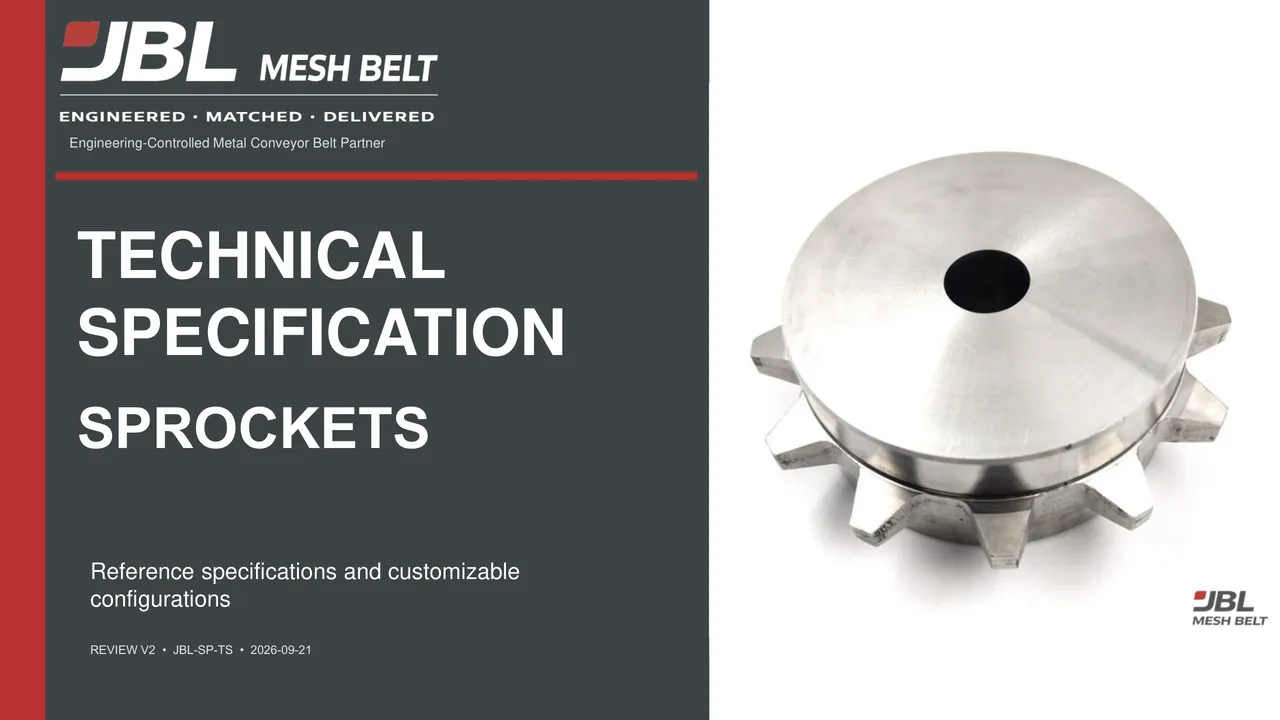
Sprocket Set in a Lined Case
A sprocket set shown in protective packing. Compatibility requires confirmation of pitch, tooth profile, bore, keyway and quantity against the project drawing.
Rolled Eye Link Belt Sections
Additional finished belt sections recorded in rolled form. The image documents visible belt construction and condition only.
Full-Width Eye Link Belt View
A full-width workshop view showing the belt surface and edge construction. It does not establish drive compatibility or installed-line performance.
These records show visible product, component and packing condition. Final belt-to-sprocket fit and operating acceptance remain project-specific and follow the confirmed drawing and agreed checks.
Controlled Documents & Project Information
Request the Record That Fits Your Project
Download the specification and the production QC file directly. Project records below are prepared for your order on request.
Watermarked Technical Specification (2026-10-02)
Project reference for Eye Link Belt structure, dimensions and options. Final material, tolerances, drive interface and revision follow the confirmed project drawing.
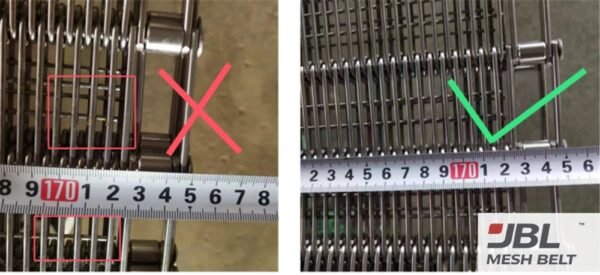
Reinforcing bars must be straight, rollers are checked by hand for a smooth surface, and the belt is wiped after cleaning. Pitch is measured over ten pitches, not one. The photos below come from our own inspection training file.
Black residue after cleaning, rejected
The belt is cleaned again and re-checked before packing.
Rough roller surface, rejected
Rollers are checked by hand. Rough ones are replaced.
Pitch measurement: wrong and right
The tape is held tight across ten pitches and the result is averaged.
Questions Before You Order
Six Questions Buyers Ask Before Ordering
How do I know whether an Eye Link Belt is the right route for my line?
Send the product size, load, process, transfer points and required drainage or airflow. JBL Mesh Belt reviews the support surface, open area and edge route; the final belt route follows the project review and confirmed drawing.
Which Eye Link Belt parameters do I need to confirm?
Share any known width, eye-link pitch, rod pitch, wire and rod diameters, material, temperature and cleaning conditions. JBL Mesh Belt checks how these values work together, and final dimensions follow the confirmed drawing or sample review.
How do I confirm that the belt will match my drive system?
Provide photos of both belt edges, sprockets and shaft arrangement, plus tooth count, bore, keyway and known pitch data. JBL Mesh Belt reviews the edge construction and sprocket engagement together before the drive interface is confirmed.
Can my existing Eye Link Belt be replaced without the original drawing?
Send full-belt, edge, joining and damaged-area photos, the dimensions you can measure and a physical sample when available. JBL Mesh Belt compares the old belt and equipment interface, then records the agreed replacement route in the confirmed project drawing.
What should I check for installation and cleaning?
Share the belt path, transfer and guide clearances, joining method, wash chemicals, cleaning frequency and drying conditions. JBL Mesh Belt reviews edge clearance, surface and accessory details; installation and cleaning instructions follow the confirmed project configuration.
What information should I send for an Eye Link Belt quotation?
Send the application, operating conditions, available dimensions, edge and accessory needs, sprocket details, quantity, delivery target and required records. JBL Mesh Belt identifies any missing review points and prepares the quotation against the confirmed project scope.
All listed dimensions and configuration options can be customized for the project, subject to engineering review and the confirmed drawing.
Let Us Review Your Eye Link Belt Requirement
Send a short requirement, drawing or existing belt photos. Your name, email and a brief description are enough to start.
Check the specification before you order or replace a belt
Compare pitch, wire, edge, surface and sprocket options with your equipment before you send a drawing or old-belt photos. 13 technical specifications and 11 production and quality control documents for JBL metal conveyor belts and sprockets, page by page on your phone or computer.
Hi, I'm Spring Liu, Sales Director at JBL Mesh Belt. I help spiral freezer and food processing equipment builders match, retrofit and replace metal conveyor belts.
Send me a photo or drawing of your belt. I'll review it against your equipment and tell you what fits and what is still needed.
No forms, no waiting for email. Just a direct answer.
Start WhatsApp Chat
Your photos and drawings are used only for this review.