JBL Mesh Belt JBL MESH BELT Request a Quote
Back to All Products

OEM Supply & Replacement Matching

Self-Stacking Belt for OEM Equipment & Custom Replacement

Match belt width, side-plate geometry and stacking clearances to your equipment. JBL Mesh Belt supports OEM equipment builders, distributors and replacement buyers from specification review through delivery follow-up.

A drawing, sample or existing belt photos are enough to start the conversation.

JBL Mesh Belt Self-Stacking Belt section showing side plates and stacked connections

Configurations

Standard / Heavy duty

Material options

SUS304 / SUS316

Start with Your Project

What Do You Need the Belt to Do?

OEM Equipment Builders

Developing a self-stacking system?

Share belt width, product load, tier layout and operating conditions so we can review the belt structure with your equipment requirements.

Review My OEM Requirement

Distributors & Belt Suppliers

Need a clear specification for your customer?

Send the drawing or sample reference, quantity and delivery needs. Confirm the structure and records needed for repeat orders.

Discuss My Supply Requirement

Replacement Buyers

Replacing an existing belt?

Start with belt photos, side-plate details and the running issue. Include tower information or a sample if the original drawing is missing.

Review My Replacement Belt

Fit & Specifications

Compare Standard and Heavy-Duty Options

Reference values from the technical specification. Confirm the complete configuration, material, tolerances and equipment fit for your project.

Standard Self-Stacking Belt Dimension Drawing

Standard structure drawing. Open the image to see the measurement positions.

Side-plate details & heavy-duty drawing

Standard Side-Plate Height Drawing

Heavy-Duty Self-Stacking Belt Dimension Drawing

Self-Stacking Belt standard and heavy-duty specification options in millimetres and inches
Drawing labelStandard (mm / in)Heavy duty (mm / in)
MaterialSUS304 / SUS316SUS304 / SUS316
Belt Width420 / 580 / 640 / 660 / 760 mm (16.54 / 22.83 / 25.20 / 25.98 / 29.92 in)660 / 760 / 1069 mm (25.98 / 29.92 / 42.09 in)
Rod Diameter5.0 mm (0.197 in)6.0 / 7.0 mm (0.236 / 0.276 in)
Side Guard Height60 mm (2.362 in) / 80 mm (3.150 in) / 90 mm (3.543 in) / 100 mm (3.937 in) / 120 mm (4.724 in)80 mm (3.150 in) / 100 mm (3.937 in) / 150 mm (5.906 in)
Side Guard Thickness1.5 mm (0.059 in)1.5 mm (0.059 in)
Rod Pitch30 mm (1.181 in)30 mm (1.181 in)
More dimensions, materials & finish details
Self-Stacking Belt standard and heavy-duty specification options in millimetres and inches
Drawing labelStandard (mm / in)Heavy duty (mm / in)
Spiral Pitch6 / 9 / 13 mm (0.236 / 0.354 / 0.512 in)6 / 9 / 13 mm (0.236 / 0.354 / 0.512 in)
Spiral Wire Diameter1.4 / 1.5 / 1.6 / 1.7 / 1.8 mm (0.055 / 0.059 / 0.063 / 0.067 / 0.071 in)1.4 / 1.5 / 1.6 / 1.7 / 1.8 mm (0.055 / 0.059 / 0.063 / 0.067 / 0.071 in)
Reinforcement Piece—4 x 15 mm (0.157 x 0.591 in) (where specified)
Turn Ratio1.6 / 1.7Confirmed per project
Belt LengthCustom (m or ft)Custom (m or ft)
Surface TreatmentPickling / ElectropolishingPickling / Electropolishing

Final dimensions and tolerances follow the approved project drawing. Heavy-duty turn ratio and reinforcement selection are confirmed per project.

Request the Watermarked Technical Specification

Only have part of the data? Send the drawing, original-belt photos, or the dimensions you can measure; JBL Mesh Belt will identify what still needs confirmation.

Start Specification Review

Structure Options

Find the Configuration Closest to Your Requirement

The three configurations below come from the technical specification. The full belt and equipment requirements determine the final selection.

Standard Structure

Standard Structure

Standard construction shown in the specification. Confirm the side-guard height, belt width and rod dimensions for your equipment.

Heavy-Duty Structure

Heavy-Duty Structure

The heavy-duty specification lists 6.0 / 7.0 mm cross rods. Select the configuration against your load and equipment requirements.

Heavy Duty with Reinforcement

Heavy Duty with Reinforcement

The reinforced configuration includes a 4 x 15 mm reinforcement piece in the specification. Confirm the complete arrangement before ordering.

More original belt, side-plate & connection photos

Side-plate and open-mesh overview

Side-plate and open-mesh overview

Belt surface and cross rods

Belt surface and cross rods

Side edge and rod connections

Side edge and rod connections

Mesh and side-plate structure

Mesh and side-plate structure

Connection edge close-up

Connection edge close-up

Layer-to-layer space

Layer-to-layer space

This photo shows the space between stacked layers; it does not measure overall belt width.

Stacked edge connections

Stacked edge connections

Formed side plates and welded connections

Formed side plates and welded connections

A structure close-up; no dimensional reading is shown.

Stacked side-plate connections

Stacked side-plate connections

Layer and side-plate arrangement

Layer and side-plate arrangement

Mesh surface viewed along the belt

Mesh surface viewed along the belt

Open-mesh and side-plate arrangement

Open-mesh and side-plate arrangement

Stacked side plates from the end

Stacked side plates from the end

Finished belt section from above

Finished belt section from above

Belt and side plates viewed at an angle

Belt and side plates viewed at an angle

Belt surface and connection edge

Belt surface and connection edge

Finished belt section

Finished belt section

Inspection Photos & Videos

See the Measurements, Turning Layout, and Order Checks

These are sample inspection, layout, and workshop records. The readings shown describe the photographed samples; your order is checked against its agreed specification and test inputs.

Side-guard height check

Side-guard height check

The sample photo shows a 90.00 mm reading. It is a project example, not a universal requirement.

Rod-pitch check

Rod-pitch check

The sample photo shows a 30.00 mm rod-pitch reading.

Cross-rod diameter check

Cross-rod diameter check

The sample photo shows a 5.00 mm cross-rod reading.

More original measurement photos

Side-guard height measurement

Side-guard height measurement

Sample height measurement. Confirm the required height against your drawing.

Side-guard height inspection

Side-guard height inspection

The caliper is positioned vertically at the side guard, rather than across the overall belt width.

Wire measurement close-up

Wire measurement close-up

The caliper is positioned on a wire. This is not a side-plate height measurement.

Wire measurement from another angle

Wire measurement from another angle

Wire and rod connection detail with a caliper; use the full drawing to identify the required dimension.

Width reference with partial tape view

Width reference with partial tape view

Only part of the tape and belt is visible. A complete width measurement needs both endpoints.

Edge and partial width reference

Edge and partial width reference

A partial tape view for reference; it does not establish side-plate pitch.

Spiral-pitch measurement

Spiral-pitch measurement

The caliper spans adjacent mesh features. Compare the measurement location with the specification drawing.

Wire-diameter check

Wire-diameter check

The sample photo shows a 1.60 mm wire-diameter reading.

Belt Dimension Inspection

0:55

Sample footage showing dimension checks and belt details. Use your confirmed drawing to determine the required dimensions.

Curved-Belt Dimensional Check

0:08

A curved belt laid out with a tape measure to discuss turn-path geometry. It does not establish a powered drum running test; drum diameter, direction, load, speed, and acceptance points are agreed for the project.

Drum / Stacking Test Requirements

The order-specific drum diameter, turn ratio, CW or CCW direction, tier geometry, load, speed, and acceptance points are agreed before a test record is treated as project evidence.

  • Stacking engagement and side-plate alignment through the curve
  • Turning path, tier clearance, and interference points
  • Drive or guide contact against the confirmed geometry
  • Dimensions, material records, connections, and weld finish
Discuss My Test Requirements
More inspection, measurement & workshop videos

Side-Guard & Dimension Inspection

0:36

Caliper and tape measurements of a sample belt. A dimensional video does not establish the material grade.

Workshop Belt Overview

0:15

A workshop overview of stacked belt sections. This is not an installed production-line running test.

Handheld Material Screening

1:25

A handheld analyser used on metal components. Confirm the test method and order-specific material documentation with our team.

Welding Process Reference

0:18

Workshop footage of a welding setup. Inspection requirements and acceptance criteria are confirmed for each order.

Manual Welding Process

0:18

An operator working on a belt section. The footage shows the process rather than a complete weld-inspection result.

Additional Belt Dimension Checks

0:33

Measurements and a belt overview. A trial length or an installed-line performance result is not established by this footage.

Replacement & Equipment Fit

Start with the Problem You Need to Resolve

Belt appearance alone cannot confirm compatibility. Show us the existing belt, the affected area and the equipment conditions so the relevant details can be reviewed together.

Rubbing or binding between layers

Compare side-plate height, formed profile, rod clearance and the contact area. Include a short running video showing where interference occurs.

An old belt that is difficult to match

Send views of both edges, overall width, rod and spiral pitch, and the tower layout. A sample can help clarify details missing from a drawing.

Uneven stacking or connection wear

Show the affected area, operating load and equipment condition. Confirm the cause before selecting a replacement structure or changing dimensions.

Curved belt arrangement & condition references

These photos identify areas to discuss. They do not establish the cause of damage, prove a repair result or document an installed running test.

Belt arranged along a curved path

Belt arranged along a curved path

A static curved arrangement. Running performance needs a separate equipment review.

Irregular layer and side-plate alignment

Irregular layer and side-plate alignment

Marked area at a side-plate connection

Marked area at a side-plate connection

Stacked side-plate alignment reference

Stacked side-plate alignment reference

Marked contact areas on side plates

Marked contact areas on side plates

Discoloration and deposits near a weld

Discoloration and deposits near a weld

Side-plate and adjoining belt reference

Side-plate and adjoining belt reference

Weld-area surface and rod connection

Weld-area surface and rod connection

Uneven weld-area surface

Uneven weld-area surface

Send My Existing Belt Details

Completed Replacement Project Record | Malaysia

420 mm Self-Stacking Belt: From Confirmed Drawing to 555 m Bulk QA & Packing

An anonymized OEM replacement record showing the controlled path from drawing confirmation and first article through a static turn layout, two production batches, and packing.

01

Confirmed drawing

The replacement structure and dimensions were fixed on the project drawing before production release.

02

Physical sample & first article

The physical sample and first article supported confirmation of the 420 mm structure, pitches, diameters, and side-plate geometry.

03

Static full-turn layout

The belt was laid through a complete curved path to review the 1.7 turn geometry and side-plate arrangement.

04

Two-batch bulk QA

Representative dimensional checks were recorded for the 185 m and 370 m production batches, totaling 555 m.

05

Packing

Finished belt sections were placed in the export crate after the agreed inspection stages.

Static Full-Turn Layout

Static Full-Turn Layout

The complete curved path was laid out for geometry review at the confirmed 1.7 turn ratio.

Confirmed Project Specification

Material
SUS304
Belt width
420 mm (16.54 in)
Total supply
555 m (1,820.87 ft)
Production batches
185 m + 370 m
Spiral / rod pitch
9 / 30 mm (0.354 / 1.181 in)
Wire / rod diameter
1.6 / 5.0 mm (0.063 / 0.197 in)
Side plate
1.5 × 60 mm (0.059 × 2.362 in)
Turn ratio
1.7
Edge & finish
Welded; pickled, cleaned and dried

Physical Sample & First-Article Structure

Physical Sample & First-Article Structure

The side plate, cross rod, and spiral relationship recorded after the confirmed-drawing stage.

185 m Batch Dimensional Check

185 m Batch Dimensional Check

A representative spiral-pitch check from the first bulk-production batch.

370 m Batch Dimensional Check

370 m Batch Dimensional Check

A representative rod-pitch check from the second bulk-production batch.

Export Crate Before Closure

Export Crate Before Closure

Finished belt sections placed in the crate before closing; customer labels and shipping paperwork are excluded.

First-article dimensional evidence

Side-Plate Thickness Check

Side-Plate Thickness Check

First-article caliper record for the confirmed 1.5 mm side plate.

Spiral-Wire Diameter Check

Spiral-Wire Diameter Check

First-article caliper record for the confirmed 1.6 mm spiral wire.

Rod Diameter Check

Rod Diameter Check

First-article caliper record for the confirmed 5.0 mm rod diameter.

Rod Pitch Check

Rod Pitch Check

First-article caliper record for the confirmed 30 mm rod pitch.

Spiral Pitch Check

Spiral Pitch Check

First-article caliper record for the confirmed 9 mm spiral pitch.

Evidence boundary: this anonymous record documents the confirmed-drawing stage, first-article dimensions, a static full-turn floor layout, representative checks from the 185 m and 370 m bulk batches, and pre-closure crating. The floor layout is not a powered drum or installed-line running test. No drum diameter, installed performance, or interchangeability result is published; final equipment fit follows the confirmed project drawing and agreed validation scope.

Your JBL Mesh Belt Team

From Specification Review to Delivery Follow-Up

A clear requirement, confirmed drawing and visible order progress help your purchasing, engineering and maintenance teams work from the same information.

01

Review the requirement

Your project contact gathers drawings, belt photos, the operating issue and required delivery date.

02

Confirm the specification

Engineering identifies the dimensions and structure needing confirmation. Sample or trial requirements are agreed for the project.

03

Produce & inspect

Production and QC follow the approved drawing and the inspection requirements agreed for your order.

04

Update & follow delivery

For active orders, the progress-update schedule and available shipment milestones are confirmed according to the agreed order scope.

Rolled belt and side-plate arrangement

Rolled belt and side-plate arrangement

Belt with protective wrapping

Belt with protective wrapping

More original finished-belt & packing photos

Finished belt surface on the workshop floor

Finished belt surface on the workshop floor

Extended belt view before packing

Extended belt view before packing

Side plates along a curved belt section

Side plates along a curved belt section

Controlled Documents & Project Information

Request the Record That Fits Your Project

Request by email. JBL Mesh Belt confirms the product, equipment and project scope before sending the applicable controlled watermarked copy.

Watermarked Technical Specification (2026-10-02)

Structure and dimension fields for standard or heavy-duty review. Final material, geometry, tolerances and revision follow the confirmed project drawing.

Request by email

Production Process & Quality Control — Without Equipment (Watermarked)

A controlled product-process reference without equipment details. The applicable watermarked copy is sent after the Self-Stacking Belt request and project scope are reviewed.

Request by email

Self-Stacking Belt Replacement & QC Record

Organizes the drawing or sample reference, known belt dimensions, stacking evidence and the inspection points agreed for a replacement project.

Request by email

Need another project record? Use the controlled-document catalog or send the drawing and evidence you have. View all Self-Stacking Belt document requests.

Additional material, inspection & packing document requests
Other conveyor surfaces (application illustrations)

These application illustrations include different conveyor-belt constructions. They are not Self-Stacking Belt installation records. Use photos of your actual belt and equipment for matching.

Bread on an open-mesh surface

Bread on an open-mesh surface

Dumplings on an open-mesh surface

Dumplings on an open-mesh surface

Biscuits on a dense belt surface

Biscuits on a dense belt surface

Seafood on a metal belt surface

Seafood on a metal belt surface

Food on a belt with side guards

Food on a belt with side guards

Food on a blue conveyor surface

Food on a blue conveyor surface

What We Check Before Shipment

With the belt collapsed, side plates must sit parallel with an even gap. Welds are pressed by hand, rods must slide freely in the slots, and sprockets are packed fixed in the case. The photos below come from our own inspection training file.
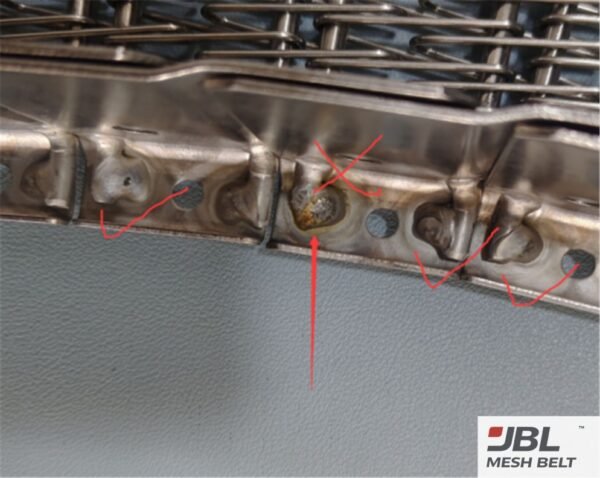
JBL Mesh Belt self-stacking belt inspection: weld defects on a side plate, rejected

Weld defects on a side plate, rejected

Each weld on the side plate is checked. Defects are reworked and inspected again.
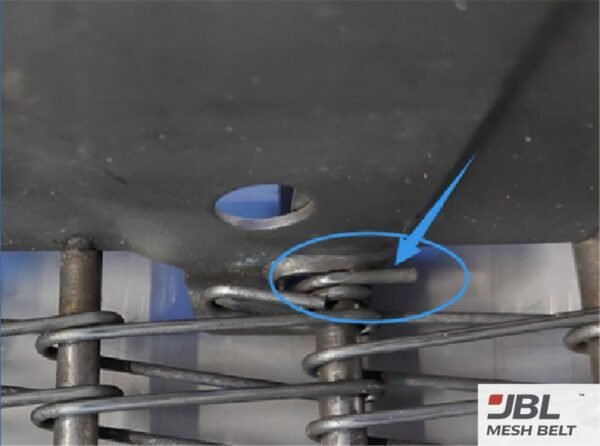
JBL Mesh Belt self-stacking belt inspection: rod binding in the slot, rejected

Rod binding in the slot, rejected

The rod must slide freely so the belt can collapse and stack.
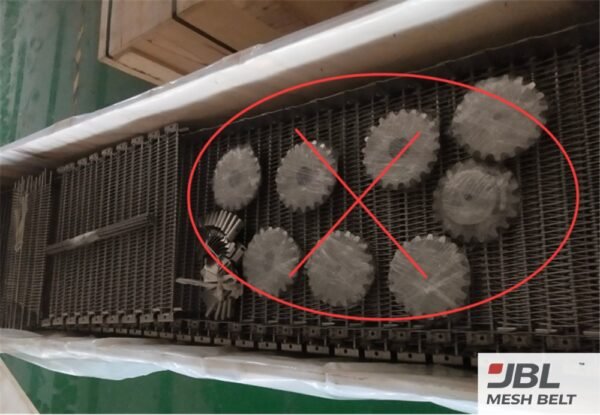
JBL Mesh Belt self-stacking belt inspection: sprockets loose in the case, rejected

Sprockets loose in the case, rejected

Sprockets are fixed and separated before the case is closed.

Six Questions Buyers Ask

What Should I Confirm Before Ordering?

Should I choose the standard or heavy-duty Self-Stacking Belt?

Send the product, load, belt width, tier height, side-plate height, and freezer arrangement. JBL Mesh Belt compares the standard, heavy-duty, and reinforcement routes with the equipment and operating conditions; the selected structure is fixed on the confirmed drawing.

Which dimensions and direction must I confirm before ordering?

Confirm belt width, spiral and rod pitch, wire and rod diameter, side-plate height and thickness, reinforcement where needed, turn ratio, and CW or CCW direction. JBL Mesh Belt records the agreed values against the drawing or original-belt sample.

Will the belt stack, turn, and work with my drum and drive?

Send the drum diameter, belt width, turn ratio, running direction, tier layout, drive details, and sprocket photos where used. JBL Mesh Belt reviews stacking engagement, clearances, turning geometry, and the agreed drum or stacking test points before release.

Can you review a replacement when the original drawing is missing?

Yes. Send views of the full belt, both side plates, damaged areas, ruler or caliper readings, tower photos, and a physical sample when available. JBL Mesh Belt identifies missing data and compares the replacement with the original structure and confirmed equipment geometry.

What should we confirm for installation, stacking clearance, and cleaning?

Confirm CW or CCW direction, joining method, tier height, maximum product clearance, guide and side-plate contact, temperature, washdown route, and cleaning chemicals. JBL Mesh Belt reviews material, surface, connection, and clearance points; final installation and cleaning requirements follow the equipment and confirmed specification.

What should I send for a useful quotation?

Send the freezer brand and model, belt width and length, drum diameter, turn ratio, direction, tier height and count, side-plate details, pitch and diameter measurements, product, load, temperature, cleaning method, quantity, destination, and available photos, drawing, or sample.

All listed dimensions, side-plate details, structures, and project configurations can be customized, subject to engineering review and the confirmed drawing.

Let Us Review Your Self-Stacking Belt Requirement

Send a short requirement, drawing or existing belt photos. Your name, email and a brief description are enough to start.

Request a Quote

Read the documents for this belt

Self-Stacking Belt: specification and production & quality control process, page by page

Opens in a new tab · no download · no sign-up

Document Library

Check the specification before you order or replace a belt

Compare pitch, wire, edge, surface and sprocket options with your equipment before you send a drawing or old-belt photos. 13 technical specifications and 11 production and quality control documents for JBL metal conveyor belts and sprockets, page by page on your phone or computer.

Engineering review

Not sure which specification fits your line?

Send your drawing or old-belt photos on WhatsApp. We compare them with the specification and tell you what still needs to be measured.